
SEO, AiEO and GEO: Built for Search Engines and the AI Answer Layer
We are an SEO agency in South Africa with active practices in AI Engine Optimisation (AiEO) and Generative Engine Optimisation (GEO). Search has changed structurally. Google's AI Overviews, ChatGPT, Perplexity, Microsoft Copilot and other generative tools are now answering questions that used to send traffic to your site. Ranking in traditional search results is no longer enough. You need to be the source those AI engines cite — and that requires a different approach to content, structure, and authority than most SEO practices were built for. We built that approach. This page explains it.
Search has a new layer. Most SEO practices haven't caught up.
For two decades, SEO meant one thing: rank higher in Google's blue links. The goal was page one. The mechanism was understood — technical health, keyword relevance, backlink authority, content quality. That model still applies. But it is no longer the complete picture.
Google now answers questions directly in AI Overviews before the user reaches any organic result. ChatGPT and Perplexity are answering commercial queries and recommending suppliers. Microsoft Copilot is summarising industries and suggesting vendors. These AI engines don't rank your page — they either cite you or they don't. And the factors that determine whether you get cited are different from the factors that determine whether you rank.
Businesses that invest only in traditional SEO are optimising for an environment that is shrinking. Businesses that understand both are building compounding visibility across both channels simultaneously.
We have been tracking and implementing AiEO and GEO practices since AI Overviews launched in meaningful form, and before most South African agencies had a documented approach to either. This is not a rebrand of existing services. It is a genuine extension of the practice.
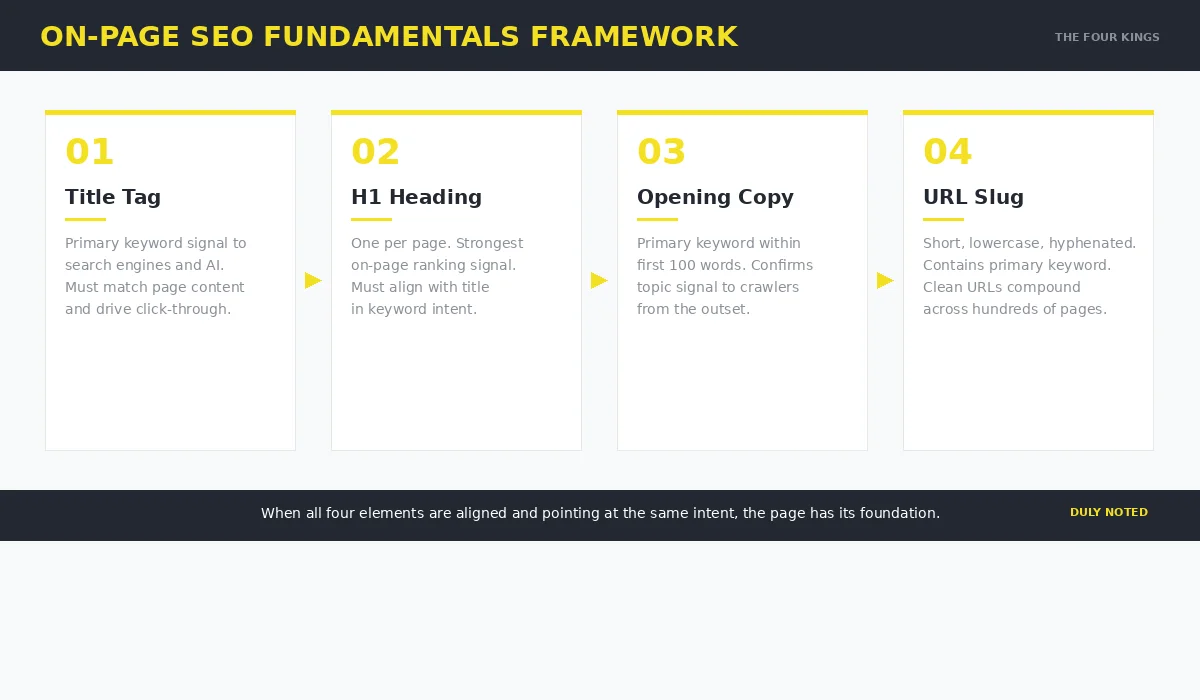
On-page SEO: the four elements that must be right before anything else matters.
Every page we optimise is built around a strict alignment of four on-page elements. These are non-negotiable — the foundation that every other optimisation decision builds on. Get these wrong and no amount of additional work compensates.
The page title
The SEO title tag is the primary signal to search engines and AI engines about what a page is about. It must contain the primary keyword, accurately represent the page content, and be written for both machine parsing and human click-through. A title tag that doesn't match the page's actual content is a misalignment that suppresses ranking and reduces click-through rate simultaneously.
The H1 heading
The H1 is the primary on-page heading — one of the strongest ranking signals on the page. There should be exactly one H1 per page. It must align with the page title in keyword intent while being written for the reader. An H1 that contradicts the title tag sends conflicting signals. An H1 that is absent entirely — which we find more often than we should — removes one of the most valuable signals available.
Opening copy
The primary keyword must appear within the first 100 words of body content. This confirms to search engines and AI engines that the page delivers what the title and H1 promised. It also ensures that crawlers processing the page incrementally receive the correct topic signal from the outset.
URL slug
The URL should be short, lowercase, hyphenated, and contain the primary keyword. Long, parameter-heavy or auto-generated URLs are harder to crawl, harder to read, and harder for AI engines to categorise. A clean URL is a small thing that compounds across hundreds of pages.
When all four of these elements are aligned and pointing at the same intent, the page has its foundation. Everything else is built on top of that.
Technical SEO: the infrastructure that makes everything else visible.
Technical SEO is the layer of work that search engines and AI engines never see directly, but that determines whether they can find, crawl, index and evaluate your content at all. A technically broken site can have excellent content and still be invisible.
Core Web Vitals and page performance
Google uses Core Web Vitals — Largest Contentful Paint (LCP), Interaction to Next Paint (INP), and Cumulative Layout Shift (CLS) — as ranking signals. These measure real user experience: how fast the page loads its primary content, how responsive it is to interaction, and how stable the layout is as it loads. Poor Core Web Vitals don't just hurt rankings — they hurt conversion rates. We assess, diagnose and fix performance issues at the code and server level, not just through plugin settings.
Crawl architecture and indexability
A site that cannot be crawled efficiently cannot be indexed fully. We audit and correct crawl architecture — robots.txt configuration, XML sitemap health, crawl budget allocation, redirect chains, orphaned pages, and the internal linking structure that tells crawlers which pages matter most. For sites with significant technical debt — common in businesses that have changed agencies or platforms multiple times — a crawl architecture audit frequently surfaces issues that have been suppressing performance for years.
Structured data and schema markup
Schema markup is the language that tells search engines and AI engines what your content means — not just what it says. FAQ schema, Organisation schema, Article schema, Product schema, BreadcrumbList, LocalBusiness — each serves a specific purpose and unlocks specific visibility opportunities. For AiEO specifically, structured data is one of the strongest signals available for getting content parsed and cited correctly by AI engines. We implement schema across every applicable page, validated against Google's Rich Results Test before deployment.
Site architecture and internal linking
How pages relate to each other — through URL structure, navigation, and internal links — tells search engines which pages are most important and how topics connect. A well-architected site concentrates authority on the pages that need to rank and distributes it efficiently across the content hierarchy. Poor internal linking is one of the most common and most underestimated technical SEO problems we encounter in audits.
On-page SEO and content built to the Information Gain standard.
Ranking in modern search — and being cited by AI engines — requires content that does more than target the right keywords. It requires content that provides genuine information gain: something the reader cannot get from the ten other pages covering the same topic. That is what gets cited. That is what gets linked to. That is what builds topical authority over time.
The content strategy decision funnel
Before we write a single word, we run every content brief through a four-stage decision process. Stage 1 — Search intent and user journey: what the user actually needs, what stage of the buying journey they are at, and what the primary function of the content is. Stage 2 — Topical authority and cluster planning: where the piece sits in the broader topical map and what role it plays in the site's authority architecture. Stage 3 — Information gain and E-E-A-T: what this page has that others don't — proprietary data, first-hand case study evidence, expert commentary, original testing. Stage 4 — Semantic breadth and entity mapping: what entities and semantic variations need to be present for the page to be understood correctly by AI knowledge graphs.
The on-page implementation blueprint
Once a content brief is approved, every page is built to a documented implementation standard that covers: strict alignment of the four core on-page elements, a TL;DR executive summary, structured data markup, meta description, H2 and H3 hierarchy with semantic variations, data formatting using tables and structured lists, FAQ section, jump links on longer pages, internal linking with descriptive anchor text, and author bio with verifiable credentials. This is not a checklist applied mechanically. It is a framework for ensuring that every page signals authority, relevance, and trustworthiness to both human readers and the machines evaluating them.
The On-Page SEO and AiEO Implementation Blueprint
Our documented standard for every page we optimise — covering the Four Kings, content structure, schema requirements, AiEO signals, and the complete on-page checklist used across all Duly Noted implementations.
Download the free blueprint →AiEO and GEO: optimising for the AI answer layer.
AI Engine Optimisation (AiEO) and Generative Engine Optimisation (GEO) are the practices of making your content, brand, and entity visible and credible to AI systems that generate answers rather than return lists of links. This includes Google AI Overviews, ChatGPT, Perplexity, Microsoft Copilot, Claude, and the growing number of AI-powered search interfaces that are changing how people find information and make purchasing decisions.
How AI engines decide what to cite
AI engines don't rank. They retrieve and synthesise. When someone asks an AI engine a question, it draws from a corpus of content it has processed and weighted by credibility, relevance, and recency. The factors that influence whether your content gets cited include: the specificity and authority of your content on the topic, the presence of structured data that makes your content machine-parseable, the breadth of third-party mentions that establish your entity's credibility, the freshness and update frequency of your content, and the consistency of your brand entity across all surfaces — your site, your Google Business Profile, your social profiles, your press mentions.
Entity establishment and knowledge graph optimisation
AI engines use knowledge graphs to understand who and what entities are, and how they relate to each other. For a business, this means ensuring that your entity — your name, your location, your services, your credentials, your relationships to other established entities — is defined consistently and verifiably across every surface where it appears. Schema markup on your site is the foundation. Consistent NAP data across directories, a well-structured Google Business Profile, verified press mentions, and authoritative backlinks all reinforce entity identity in the knowledge graph.
Why AI tools alone are not enough for AiEO
AI content tools are useful. We use them. But they produce output proportional to the quality of instruction they receive and the expertise of whoever is reviewing the result. A non-expert using an AI tool to produce SEO or AiEO content will get plausible-looking output that may be technically wrong — missing schema requirements, misaligned on-page elements, incorrect keyword intent, insufficient information gain, or entity signals that contradict rather than reinforce each other. The tool does not know the difference. It produces what it was asked to produce.
The technical specification for content that ranks in traditional search and gets cited by AI engines is specific, evolving, and requires expert direction at every stage. We direct the tools, apply the framework, and validate every output before anything is published.
GEO — Generative Engine Optimisation
GEO is the strategic layer above AiEO — the deliberate positioning of a brand, its people, and its expertise across the full ecosystem of signals that AI engines consume. That includes earned media coverage, guest content on authoritative platforms, podcast appearances, industry citations, directory listings, and the accumulation of verified third-party mentions that establish a brand as a recognised entity in its field. GEO is a long-term discipline. The brands that will be consistently cited in AI answers in 2027 are building their entity authority now.
Off-page authority: the external signals that establish credibility.
On-page optimisation determines whether a page deserves to rank. Off-page authority determines whether it gets the opportunity. Search engines and AI engines both use external signals to assess whether a source is credible, relevant, and trustworthy — and those signals come from what other sites, publications, and platforms say about you.
Link building and digital PR
High-authority backlinks from relevant, trusted sources remain one of the strongest ranking signals in traditional search, and one of the most important credibility signals for AI citation. We build links through digital PR — earning coverage and references through content worth linking to, not through directory submissions or link exchanges that create short-term numbers and long-term risk.
Local SEO and mapped locations
For businesses with physical locations or defined service areas, local SEO is a distinct discipline. Google Business Profile optimisation, citation building, local directory listings, and location-specific content all drive visibility in local search results and map pack rankings — and contribute to the "who is near me" query responses that AI engines increasingly generate.
Competitor gap analysis and topical benchmarking
We don't build authority in isolation. Every off-page strategy is benchmarked against what the strongest competitors in your space have — their backlink profiles, their topical coverage, their share of voice in AI-generated answers. The gaps in their authority are where your opportunities are.
SEO results from real implementations.
We identify what is suppressing your search visibility and your AI citation rate — and what to fix first.
Get an SEO auditSEO — traditional search ranking optimisation.
AiEO — optimising for AI-generated answer environments.
GEO — building brand entity authority across AI signal sources.
Also see: What is AiEO — explained →
SEO, AiEO and GEO — common questions
Neil has been practising SEO since the early days of South African digital marketing and has been developing and implementing AiEO and GEO methodology since AI Overviews entered mainstream search. He has delivered SEO strategies for clients across South Africa, the UAE, UK and North America, and developed the on-page and content methodology used across all Duly Noted implementations. Full background →
Find out where your search visibility is leaving money on the table.
We audit existing SEO setups and identify what is suppressing performance — technical issues, content gaps, AiEO readiness, or off-page authority deficits. We tell you what to fix and in what order. No obligation to engage us to do it.